

What We Owe Stitch Fix
Lessons from fashion-tech’s most infamous box

As will become clear in the next few minutes (or twenty…), I have a lot of thoughts and feelings about Stitch Fix.
I spent over a month drafting this piece, pouring out all my frustrations with the business model and the reasons Stitch Fix failed.
But when I stepped back, I struggled to answer: why should any of you (yes, you!) care about this? Why is Stitch Fix relevant, like at all?
It’s not like this is a particularly hot topic here on Substack. Search for Substack-famous brands like Ganni or The Row, or even more mass-appeal brands like J.Crew or H&M, and you’ll find a steady stream of relevant results. Commentary and takes galore.
Search for Stitch Fix and you’ll find…well, cross-stitchers trying to fix their stitches.


And that in itself is part of the disappointment for me.
As a data-minded girl interested in fashion and consumer businesses, at a bright-eyed and curious 25 years old back in 2016…I loved Stitch Fix! What they were doing (or claiming to do…) felt genuinely fresh. I wanted in!1

But with Stitch Fix so far out of the conversation, why—of all things!—did this claw its way to the very top of my drafts folder?
I’ve tried to keep at least a little space between what I write here at Brand Panic and what I do in my role as a co-founder at Indyx. But maybe it’s wishful thinking to believe the two could ever be separate.
Because upon further reflection, the real reason I felt the pull to write about Stitch Fix is that this company shaped so much of Indyx. And I mean that in both a (complimentary) and (derogatory) sense.
Bigger than that: Stitch Fix is deeply relevant to the current wave of fashion-tech companies. The problems they tried to solve are the same ones we’re still facing. And the traps they fell into are the same ones we’re now carefully tiptoeing around.
Stitch Fix walked so the fashion-tech startups of today could run.
So if you care about where fashion-tech is at and where it’s going, the story of Stitch Fix matters. Or even if you were just a former customer wondering why it never quite clicked, why the magic faded so fast: read on.
Ahhh, the subscription box. In 2025, it already feels obsolete. A relic of the 2010s, quickly overdone to the point of absurdity.

But back when Stitch Fix launched in 2011, e-commerce was still very new (just 7%2 of all retail sales happened online). The general vibe was that to get people to shift, the online shopping experience needed to feel very frictionless. Borderline magical.
Today, we’ll wade through a torrent of shit to get our little treats delivered to our door. We’ll roll the dice on anonymous sellers via 3rd party marketplaces. We won’t bat an eye when a haul arrives in a string of individual packages over two weeks.3 Need to return? Be ready to slice through a dizzying array of options.4
But back then, a streamlined customer experience was everything.
And the idea that a regular person could afford to have someone else pick out clothes for them, have them arrive like a little gift on your doorstep, and simply send back whatever didn’t spark joy? It felt downright delightful.
But for Stitch Fix, that moment of delight came with a catch. One single decision that set off their slow unraveling.
The trap of “Five Things in a Box”
Some decisions in life are open-door: you can step through, try things out, and walk back if needed. Others are closed-door, one-way only. And being able to tell which is which might be the most underrated life skill there is.
Katrina Lake’s choice to optimize for customer experience by putting all five things in a single box was a closed-door decision for Stitch Fix.
If everything ships in a single box, then you need to pack and ship all the items from a single location. To ship all the items from the same location, you need to buy the inventory and hold it in a warehouse yourself.
This means that “five things in a box” forced Stitch Fix to own inventory.
And owning inventory is…well, a big deal. It’s a clear line in the sand that makes you a retailer and not a tech company.5 It’s a humongous, inefficient suck on working capital. You’ll surely buy too much of one thing (the coquette cargo shorts that feel like the trend of the summer but flop by July) and not enough of another (the perfect mesh ballet flat that everyone wants, all at once).
To make matters worse, the “five things in a box” model practically guarantees a return. It’s not five things you have painstakingly chosen for yourself—it’s a guess at what you might like. And most customers keep one or two things, if that.
Any Stitch Fix customer or stylist will say the same thing: “good” inventory is always in very short supply.
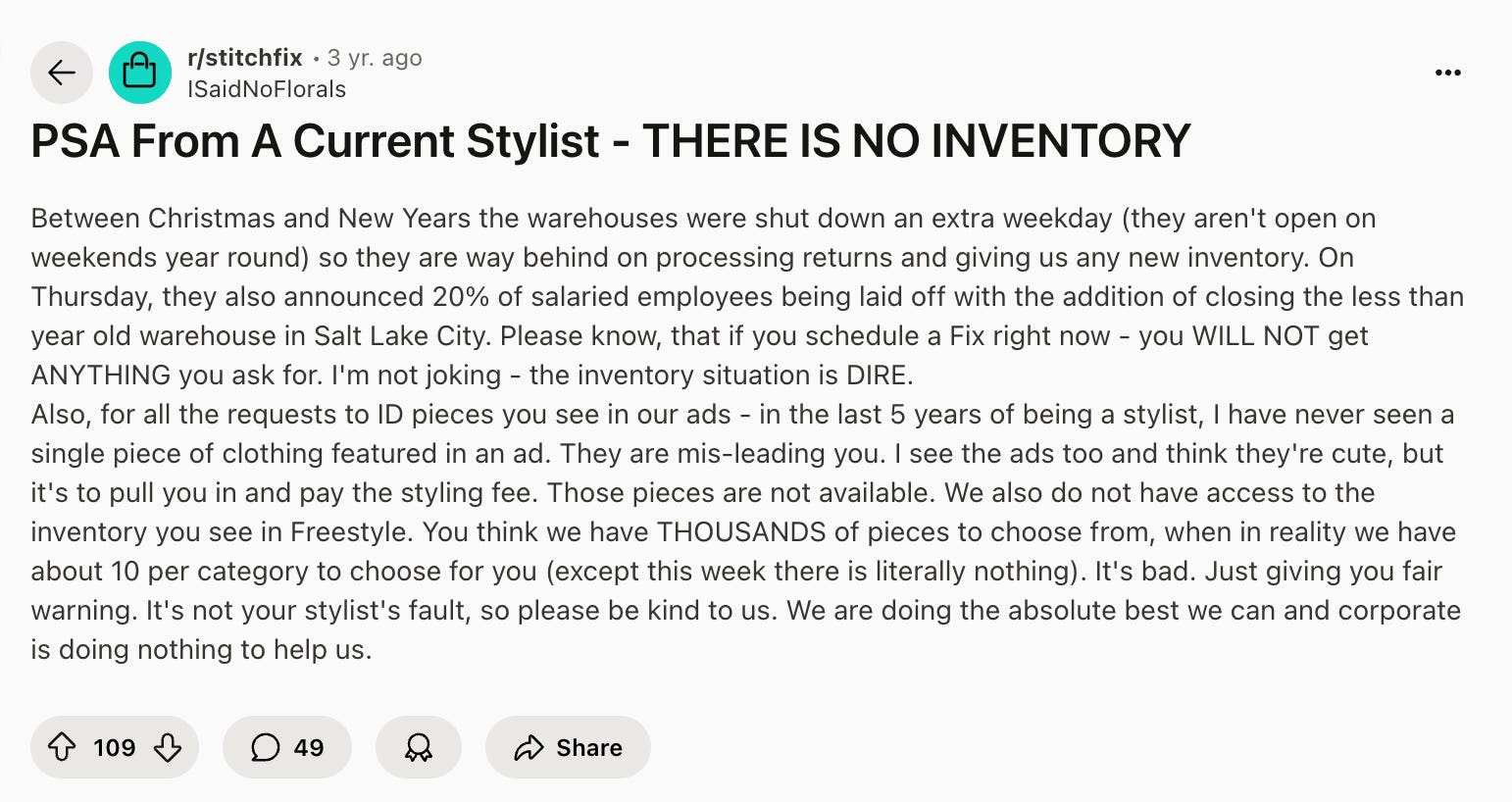
And of course it is! At any given moment, a huge slice of Stitch Fix’s balance sheet is quite literally stuck in transit, endlessly circulating between the warehouse and some half-interested doorstep.
Stitch Fix’s inventory may feel thin compared to a traditional department store’s, but the balance sheet is already groaning under the weight of this extremely capital-intensive business model.
More inventory is never coming. Not because they don’t want to, but because they literally can’t.
It’s a variation on the same problem that Rent the Runway also faces, which is why I’m highly skeptical that Jen Hyman will be able to solve the very same customer complaint (that she keeps insisting they can).

The Lesson: Avoid inventory like your life depends on it
Contrast this with an alternate reality where Stitch Fix never touches inventory at all. Instead of shipping boxes of clothes, they simply recommend items and send you to Nordstrom to check out.
This is precisely what today’s crop of shopping-oriented fashion-tech startups—Phia, Alta, Daydream, and the like—are doing. They’re all slightly different wrappers on the same basic idea as Stitch Fix: to match you with “better” things to buy. The difference is that this latest wave of companies (wisely) skips the warehouse, passes the transaction off to a retailer, and pockets their affiliate commission.
To be super clear: I’m no big fan of affiliate shopping models either. In isolation, I think they’re generally, well…doomed. Brian Sugar has already written about this so intelligently, so go read his post to learn why.

But I’m very clear on one thing: no matter how we evolve, Indyx will never own inventory. It’s one of the things we’ve been in total and complete agreement on from the very beginning. You won’t catch me with a damn warehouse!!!
Doubling down with private label
Owning inventory was the first step. But in 2017, Stitch Fix doubled down by launching its first private-label brand designed, produced, and sold entirely in-house.
And at the time, even I thought this was a smart move. If you’re already committed to holding inventory and you’ve got aaaallllllll that precious data to draw on, why not use it to make better design and purchasing decisions? That should result in better-for-your-customer product at wider margins, right?6
If I can momentarily slip into an embarrassing level of business-speak, it all seemed like the MBA wet dream of strategically leveraging your unique advantages to create significant competitive differentiation (!!!).
Was this the missing piece in fashion? Clothes designed based on real data, from real customers, in real time.
But in retrospect, all the signs were there.
It sounds wild today, but I shit you not: Stitch Fix described their private-label design process as akin to Darwinism.
As then-Chief Algorithms Officer7 Eric Colson explained back in 2017:
Nature has a selection criteria: It’s called survival. Circumstances that lead to survival, like a giraffe’s long neck, are going to pass on a certain gene,” said Colson. “We notice the same thing occurring in our inventory — any trend emerges this way. It starts spontaneously, like a mutation. The first time you see a cold-shoulder top, it’s weird and different. But if it’s successful, you see more and more styles as people buy more.
In other words, they started forcibly breeding best-selling blouses to create increasingly Frankensteinish offspring.
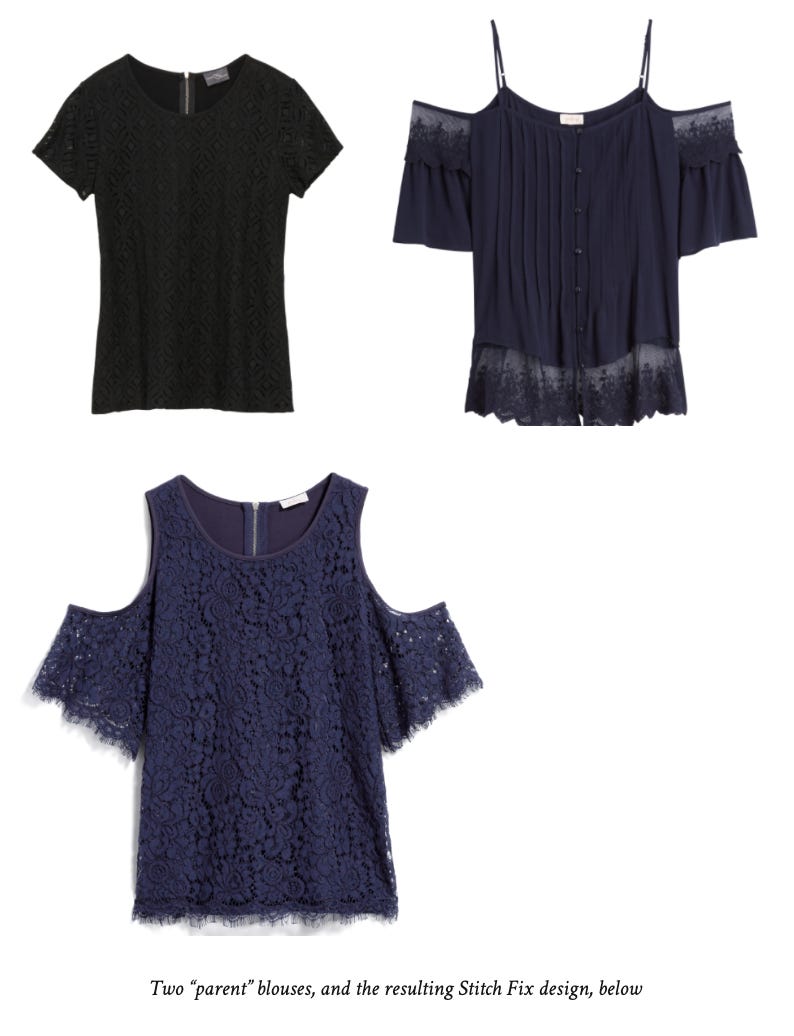
Nobody in fashion was talking about design like this. It seemed a bit crazy, but maybe crazy like a fox?
The same article also shares this very cute idea about the private-label launch:
“We’re not going to push our own brands”
Stitch Fix doesn’t broadcast it’s in-house brands much with customers, other than to flag that certain pieces are exclusive to Stitch Fix. […] Ultimately, Colson sees the Hybrid Design line remaining a small, supplementary portion of Stitch Fix’s core business.
The catch is that by their very nature, private-label brands are higher-margin brands. That’s dollars and cents, baby!
And here’s something I think everyone should more deeply internalize: companies don’t moderate themselves against what they perceive to be in their own best interest. They can’t. It’s not what they’re built to do. Maybe in the short term, they can make it seem like they’re doing “the right thing”. But if “the right thing” happens to run counter to the bottom line, it falls apart in the long term.
Every single time.
So no matter how much Stitch Fix swears that their private-label brands don’t influence the recommendations...they influence the recommendations. And that becomes especially true when that product is gathering dust in the warehouse.
Any Stitch Fix stylist will tell you: they were forced to choose pieces every day of the week that weren’t right for the customer, simply because that’s what was in inventory.
This was all a prison of Stitch Fix’s own making.
And we all know what a Stitch Fix blouse looks like, right? Imagine: a modestly roundish neckline that aggressively sidesteps any cleavage, an elbow-length sleeve with a token ruffle or ruche, and a tush-covering hem. All in a floral print.
Stitch Fix’s own customers complain about this phenomenon:
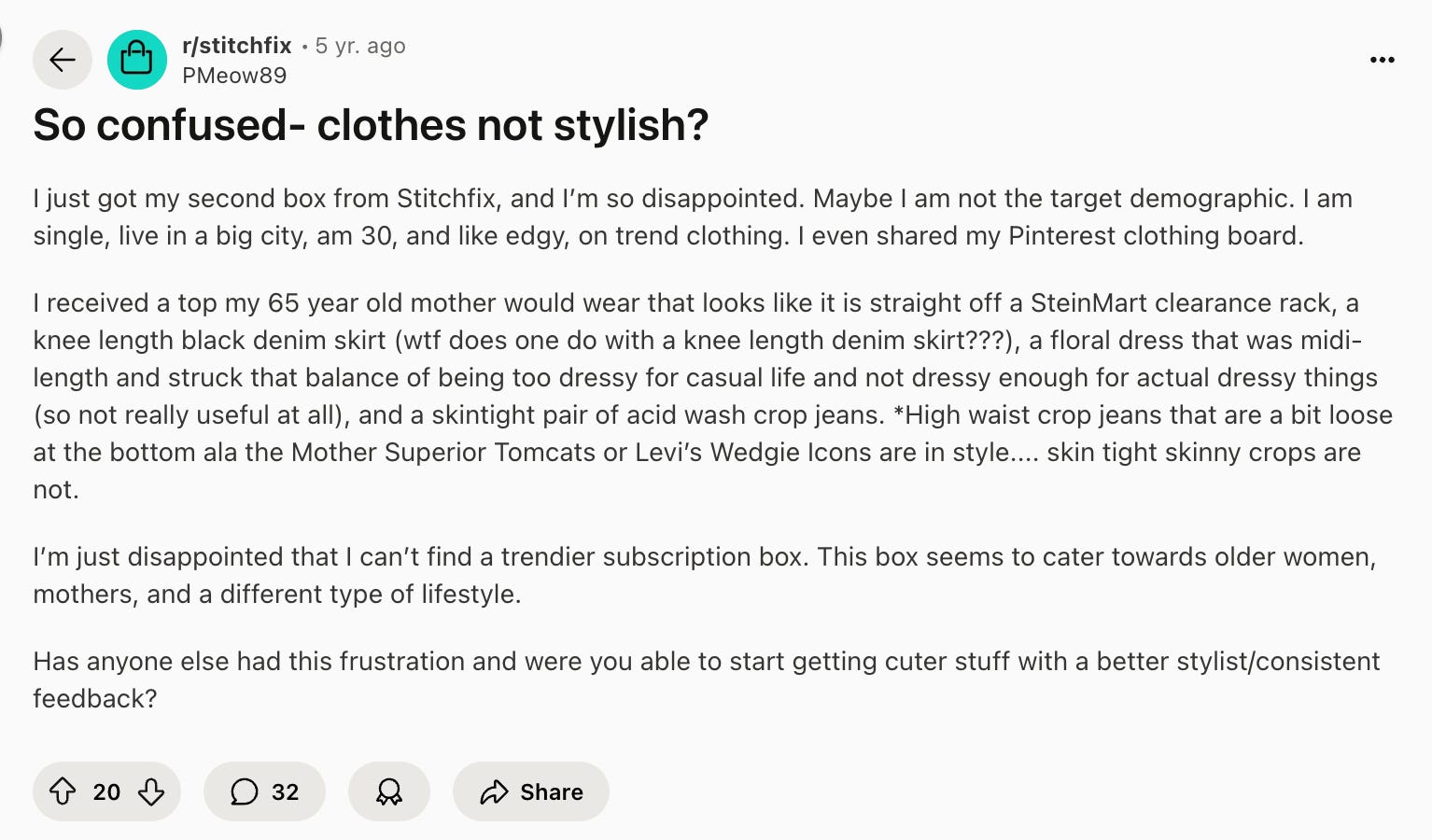
The important thing about having (human) buyers who curate brand mix is that they can direct the product vision in a forward-looking way. Their value is not only in knowing what their customer buys today, but also in anticipating what they’ll want tomorrow.
But in being so toxically “data-driven”—in this case, endlessly iterating on what customers were already buying—Stitch Fix locked the product assortment into a backwards-looking doom loop. Hence: the Stitch Fix blouse.
In their Q1 2025 Earnings Call, CEO Matt Baer openly stated:
As we've shared historically and on prior calls, our private brand composition is around 40% to 50% of our total portfolio.
Ah yes, a “small, supplementary” part of the business. How did all that “we’re not pushing our own brands” work out?
It didn’t. Because structurally, it never could.
The Lesson: Don’t try to win at your customer’s expense
If I had to sum up my entire worldview into a single idea, it’s that incentives matter. And so in business, you'd better be damn sure that you’re aligning your financial incentives (i.e., how you make money) with your customer’s core problem. If those two things don’t line up, everything goes topsy-turvy from there. And unfortunately, it takes many people 15 years and $500M in venture funding down the drain to figure that out.
Indyx is built on the hypothesis that we’re systematically undervaluing what we already own, both individually and collectively.
You have a closet full of clothes, but nothing to wear? Yeah, join the club.
But the problem isn’t what’s in your closet. Not really. It’s your mindset. It’s the absence of a real system for style and getting dressed. We’ve built endless tools for shopping, but almost nothing for the bit that comes after. You know…actually wearing the clothes in a way we like and makes us feel good.
And yeah, shopping plays a role in this big picture. It’s the inflow valve to your wardrobe. But it isn’t the core. Your closet is.
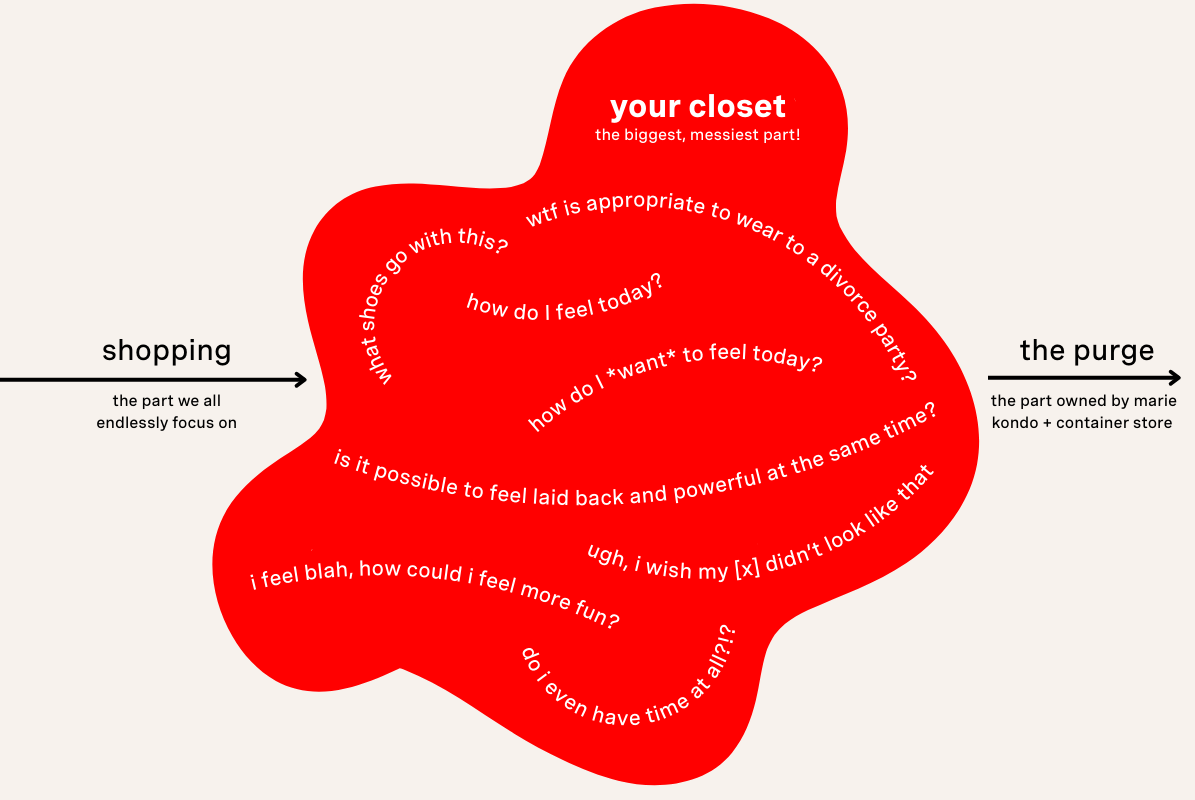
So while shopping might be a part of Indyx one day, it cannot be the thing that our business is built around. It cannot be how we meaningfully monetize, because the incentives would be all wrong.
If we sustained ourselves via shopping, we’d need to put as many “buy now” options in front of you as possible. We’d need to get scarily good at convincing you that the answer to your style problems is always yet another top. We’d need to quietly hope that you never feel all that satisfied with your closet.
Uh…isn’t that how we got into the whole “closet full of clothes, nothing to wear” pickle in the first place?
Dear reader, it is.
If we want to truly support users in solving this problem, we can’t be financially dependent on selling them more stuff. That would defeat the purpose, putting us in conflict with our own users’ goals, just like Stitch Fix did with their private-label product.
That’s why we landed on our membership model. Indyx Insider asks our own users to pay—not for clothes, but for tools that help you wear them well.
And let me be so real for a second: it’s hard to ask people for money. In this economy!? We’re so used to tech products being “free” (aka the true cost is buried in the physical goods we’re nudged to buy) that we get negative app reviews all the time from folks stunned that we’d even ask.8
It is extremely tempting to try to monetize via shopping. After all, VCs don’t (currently) know how to fund anything else in fashion! It’s the only “proven” way to exist. You make money by selling clothes, end of story.
But for what Indyx is trying to solve, we know that won’t work. We can’t try to win in ways that make our customers lose.
When the data starts driving you
From pretty early on, Stitch Fix pitched itself as, well, rather obsessed with data. And for good reason: it’s what earned them the “tech company” label—and, in turn, their tech company-sized valuations.9
So it’s no coincidence that in her 2013 interview with TechCrunch10 announcing Stitch Fix’s Series A, founder Katrina Lake explained:
We want to be prepared to serve the growth we’ve been having…and also to continue to build our tools. We are able to do what we do because we kind of have world-class tools using data analytics and algorithms to help our buyers buy better and our stylists style better, so we actually have a lot of technology and infrastructure we’ve been buiding [….] and that’s a big part of the funding as well.
But my hot (lukewarm?) take in 2025 is that Stitch Fix’s “data-driven” identity had much more negative impact on its culture than positive impact on its actual results. They hired droves of data scientists, but just never seemed to make all that much progress.
I think this is because their business decisions stretched the problem statement way too far. At first, Stitch Fix data science was solving one clear question:
#1: “How do we use data to make the best possible product recommendation?”
Then, the business decided to own inventory, and a second question got added to their plate:
#2: “How do we use data to optimize the inventory we buy?”
Then, the business decided to produce in-house brands. Throw another on the pile!
#3: “How do we use data to design better products?”
These are three entirely separate, enormous challenges. Each one, if solved, would justify a venture-funded tech company of its own. But Stitch Fix insisted on tackling all three. At the same time. It’s just impossible, organizationally.
I also find it fascinating how Stitch Fix chose to position their very human stylists within such a “data-driven” machine.
Listen carefully to how Stitch Fix Data Scientist Hoda Eydgahi explained it:
(At 3:57 in the video. And to be crystal clear: we’re not coming for Hoda here. She’s just the messenger delivering the company’s script)
We don't just take the algorithm’s top 5 most recommended items and send them to the client. Instead, we have a human in the loop. This is our stylist. A human in the loop allows us to more holistically leverage unstructured data that the client provides. For example, clients are able to leave us request notes and share their Pinterest boards. And while we’ve explored NLP (natural language processing) and computer vision algorithms to process these, humans are awesome at looking at a Pinterest board and telling you what someone’s style is like. Awesome.
It sounded real smart and respectful in 2017. In the context of the moment, this carefully choreographed messaging struck the right chord of:
Look at us being so smart! We’re disrupting fashion with grade-A Silicon Valley tech, and our message to Wall Street is: “we’re gonna blow ‘em out of the water!!!”
We 100% love and value human labor. How do we know that for sure? Well, that should be obvious, silly! Because we already know that computers can’t look at Pinterest boards (“leverage unstructured data”). Not for lack of trying, of course. We tried it. Read my lips: your job is perfectly safe with us, not because we don’t want to replace you, but because we believe we cannot replace you.
Stitch Fix positioned their stylists’ value to the company as something that only humans could do, at the time. Then…whoops! You know what’s also awesome at leveraging unstructured data? A little thing called AI.
And practically overnight, Stitch Fix’s entire organizational understanding11 of why human stylists might be valuable was thrown out the window.
Stitch Fix certainly commoditized its stylists via poor assumptions about where and how quickly technology would develop. They also commoditized their stylists by making them interchangeable hourly employees.
The business model requires it! Stitch Fix makes money from selling clothes, not from the service itself. Labor isn’t a direct revenue-driver…and so, by default, it becomes a cost to be optimized. No matter which way you skin the cat, the less time (and money!) Stitch Fix spends per box while still selling the same amount of clothes, the better.
In this model, everyone gets paid one (rather low) hourly rate.12 As a stylist, your time isn’t yours; it’s the company’s. Your clients aren’t your own; they are the company’s. It flattens all that diverse creativity into a faceless blob.
And hey! You know what’s helpful when managing the expense line of a faceless blob? Metrics. Tracking to KPIs. It’s absolute catnip for a place that self-awards the “#1 data-driven company!” badge.
And judging by the plentiful posts in r/sfstylistsupport, of all the many problems that Stitch Fix data science had to solve, optimizing the stylist organization to hell and back seemed to be their top priority.
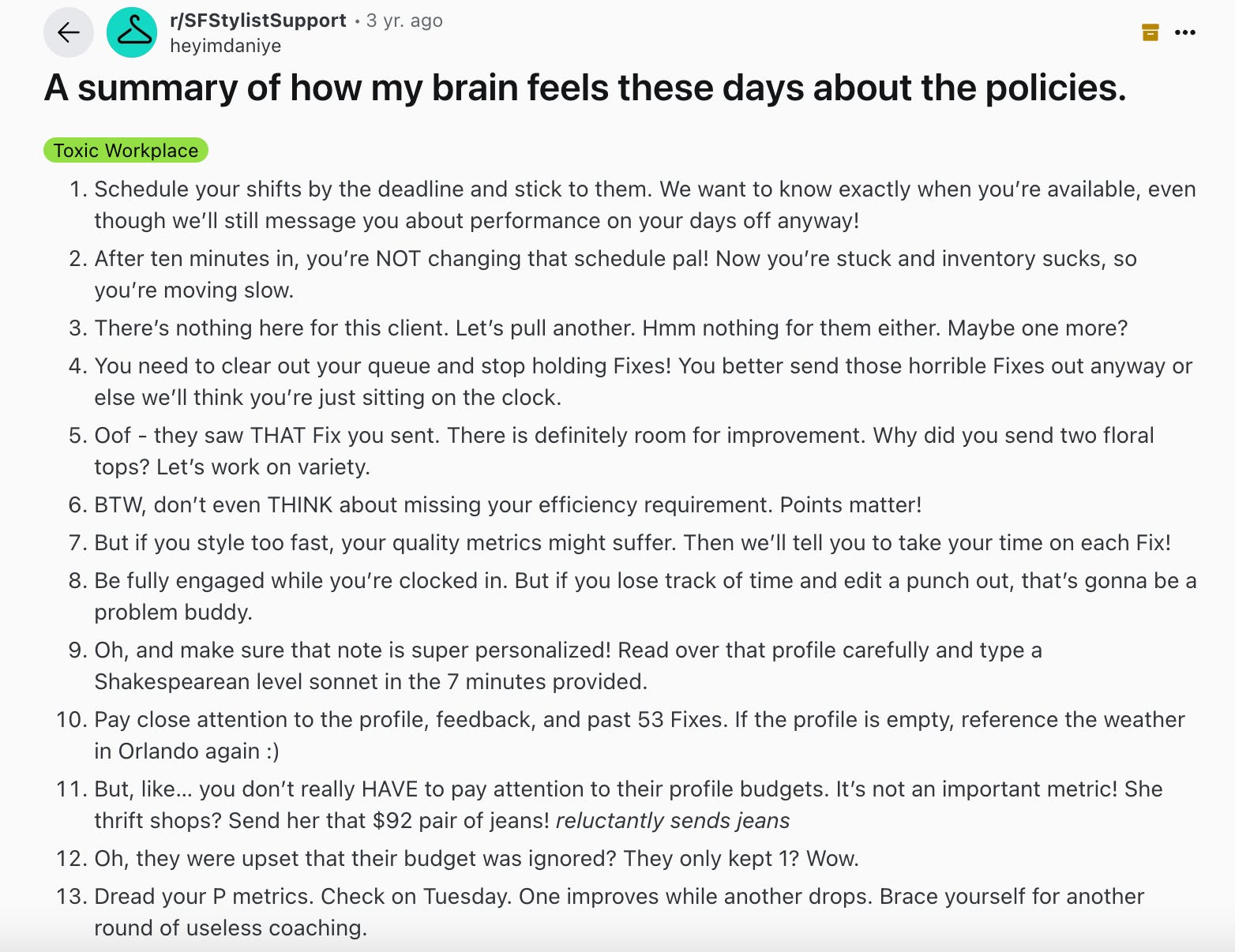
Between Stitch Fix stylists’ poor positioning within the technology model (“we only value you to do the stuff that computers can’t do quite yet”) and the business model (“you are a cost to be optimized”), it’s no surprise that the experience quickly became a race to the bottom: flat hourly pay with raises incredibly few and far between, no autonomy, just waiting for the moment when Stitch Fix will inevitably pull the ripcord.
The Lesson: Don’t flatten your stylists
At this point, you might be wondering: “Wait….aren’t you the co-founder of a fashion-tech company that uses human stylists? Don’t you have all the same issues?”
Well, no. Or at least, I hope not.
Here’s the big difference: on Indyx, stylists set their own rates. The same service might cost $150 or $450, depending on who you book, because stylists aren’t interchangeable. They’re individuals with distinct creative points of view. They’re also professionals, each running their own business.
This decision was a direct response to Stitch Fix’s model. We wanted to build a platform that offers flexibility and real earning power. And as long as a stylist communicates proactively and keeps their clients happy, they can work however, whenever, and as much as they want. It’s an entirely different approach, baked right into the business.
Now, get ready for a take that could age like milk. Real cold stuff.
Our marketplace model also makes Indyx and our stylists much more AI-resilient.
I might be wrong! But I’m still (perhaps foolishly) choosing to say it out loud, because betting on human connection still feels like the right call.
But by putting stylists front and center as the stars of their own business, we’re making their humanness part of the product itself.
You’re not just getting “outfits from Indyx” (some anonymous, amorphous blob), which would be much more easily replaced by a robot.
You’re getting outfits, handpicked for you by Alberta Rose, or Anika Kruger, or Alyssa Rudman (just to name a few). And in this model, they each bring so much more to the table than just the simple ability to “leverage unstructured data.” They bring their own layer of taste. Intuition. A point of view. And most importantly, they bring a relationship with you.
That human-to-human connection—the feeling of being seen, understood, and hyped up by someone whose style you admire—isn’t a nice-to-have. It’s the whole thing.
And so even in a world where a robot can send you an outfit, is that what you really want? There are certainly many other apps going that way. But I’m not so sure.
Stitch Fix pains me deeply because nearly 15 years down the line, fashion-tech is still trying to solve the same problem: how do we make getting dressed easier? Because it still seems pretty hard for most of us.
Stitch Fix failed because the vibes of the time pushed them into an inefficient business model that put them in conflict with…just about everyone, partners and customers included. In the end, they weren’t a new way to get dressed. They were just another retailer.
Is it even possible to reasonably scale a business in fashion that’s not dependent on shopping? I guess I’m looking to find out, and it could very well turn out that I’m the most foolish person in the room after all.
But hey, I’d rather spend my time trying to do something different than just repeating the same mistakes.
And in retrospect, what a relief that I didn’t get that job I interviewed for in Stitch Fix HQ in 2017. Things work out the way they’re supposed to, people!
Packages every day! That might even be a feature, not a bug, nowadays.
Return to store for free. Return via UPS with no packaging for $7.95. Return via USPS with printed label for $4.95. Return via UPS or USPS for no charge and a 15% boost in store credit. Return via drone pickup during daylight hours, weather permitting, for $6.69 and a high-five from a robot. Return along with a 500-word essay on why the item didn’t spark joy and we’ll consider your refund.
Got it?
And, lord knows that Stitch Fix attempted to bill itself as a tech company! More on that in a sec.
All that “cutting out the middle man”, etc.
LOL, what a job title, huh?
Hey, if that makes you REALLY mad for us and you’re a generally happy Indyx user….would you mind leaving your own review to help drown those losers out? Please and thank you!!!
$50ish million got them to their IPO. Which, I’ll give ‘em credit: it’s shockingly modest compared to other eye-popping sums from 2010s peers like Warby Parker ($535M+), Glossier ($266M and counting), Allbirds ($200M+), Bonobos ($128M), Rent the Runway ($525M+), or ThredUp ($300M+).
It’s less than Julie Bornstein’s Daydream has raised just this year.
(Hint: money raised is an catastrophically bad proxy for success, but that’s a rant for another day)
If you have the time, I’d recommend watching the whole thing. This is exactly the kind of “but how were they talking about it at the time…?” forensics I live for.
Please note: organizational understanding does NOT = the understanding of individuals in the organization! Those are two separate things.
Point of order: pay seems to start at $16.50 an hour and scale up to…a whopping $19.50 an hour. That’s functionally flat to me, but my fact-checking husband made me include this footnote.
Devon I *really* adore these deep dives because hearing how your brain thinks in regard to the good/bad/ugly of fashion commerce feels like learning from a professor. I never used StitchFix BUT my husband did and- frankly- it was built for men who don’t care too much because they aren’t as likely to return AND they won’t know/care if they are being pushed bad inventory because men’s inventory quality feels relatively flat. That’s my (slightly) uneducated take.
What an interesting read! Living in little Norway I’ve never had access to a fashion subscription service and loving my money too much AND hating waste, I could never fathom letting someone else choose which clothes I buy. I’ve been an on and off subscriber to Goodie box and am delirious when all five products are a hit, but most often just sad that I paid Nok 350 for yet another product (or five) that I’d never buy myself.
I use Indyx every day and I’m so extremely happy that it’s not about shopping, but rather about using and reusing what you own. Pls never ever incorporate shopping links! We’re happy to pay for other apps that help us or provide information, so why not pay to make better use of our wardrobes and to be inspired? After all, we’re getting dressed every day, whether we like it or not.